Fall 2024
HRSJ 5010 – Foundations of Human Rights and Social Justice
HRSJ 5020 – Indigenous Ways of Knowing: Resurgence of Land Based Pedagogies and Practices
HRSJ 5710 – Food, Art, and Community Empowerment
Winter 2025
HRSJ 5030 – Problem Solving in the Field
HRSJ 5120 – Settler Colonization: Decolonization and Responsibility
HRSJ 5130 – Body Rights: System and Social Movements
Summer 2025
HRSJ 5040 – Practicum
Fall 2025
HRSJ 5140 – Art, Media & Dissent: Bridging the Local & Global from Guerrilla Girls to the #MeToo Movement
HRSJ 5250 – Risk, Place, and Social Justice in a Turbulent World
All the courses have changed my perspective, way of thinking, and acting; they have opened my mind and intrigued me to step out of my comfort zone and learn from different people and worldviews. Two of them have a special place in my heart: Indigenous Ways of Knowing and Settler Colonization: Decolonization and Responsibility. Both emphasized the importance of decolonizing the system and fostering truly diverse relationships with different perspectives.
In the Indigenous Ways of Knowing course, I learned more deeply how much Indigenous peoples have suffered since colonization and how they are still ignored by authorities and, worst of all, by people who see but close their eyes to injustices. I also gained a more profound understanding of Indigenous peoples from my own country and realized that a racist and prejudiced system has continued to crush them to this day. This made me feel the urgent necessity of decolonizing ourselves, which I believe is the most essential step in decolonizing the entire system.
We need to understand that we are the system, and we must take responsibility for our accountability to make a difference now and for future generations. We cannot change a group without changing ourselves. By understanding others’ lives and perspectives, we strengthen our relationships, and together we can make a difference in closing the gaps between marginalized people and privileged groups. The wealth of knowledge held by marginalized people who, for countless reasons, lack access to academic training is unbelievable, and their experiences should be valued. I’ve always believed that individual experiences should be validated as knowledge, not just those of people with academic privilege or financial resources. Social class, race, and gender should not be the exclusive basis for decision-making because, in addition to reinforcing oppression, this undermines creativity and the diversity that makes each person unique, further deepening social inequality.
A great reading in this class was Elements of an Indigenous Research Paradigm, a text from the book Research Is Ceremony: Indigenous Research Methods (Wilson, 2008). I loved it so much that I bought the book, and it confirmed to me how essential it is for each of us to take accountability in the journey of decolonization. Indigenous ways of knowing value and include the experiences of each individual, offering different perspectives and solutions. In contrast, colonial views stem from racism, classism, and gender bias, framing us within a single way of thinking that weakens our creativity, spontaneity, and truthfulness. The author points out that “any research conducted on Aboriginal people in either country was based upon a racism that deemed them inhuman. Unfortunately, the effect of this research has forever racialized their existence” (Wilson, 2008, p. 48). This made me realize that most of what we know today has been shaped by a racist perspective, and we must change that. Wilson explains how the Indigenous paradigm relates to relational accountability and how, during their ceremonies, people listen to and understand one another, consciously knowing that every action affects others. He says, “Let us go forward together with open minds and good hearts as we further take part in this ceremony” (Wilson, 2008, p. 11). This cherishes my heart. It gave me the strength to continue my journey to listen, understand, and act in favour of minority groups, especially to empower women who are suppressed in abusive relationships, believing they are not good enough to rise and shine in their beauty. Women are strong, beautiful, creative, intelligent, and resilient, and they need to be recognized and empowered to unleash their self-confidence and shine.
The Settler Colonization: Decolonization and Responsibility course was the most decolonized teaching approach I have ever experienced. I could truly be myself and express my ideas through the arts, which I believe is an effective way to connect with others and share knowledge. The puzzle I created represents my geographic map as my body, built from who I am and everything I have learned in life. In this map, I have my soul, everything I am, everything I feel and care about. Place is where I feel whole and free to be myself; it is where I feel I belong, and I belong when my soul is fulfilled.
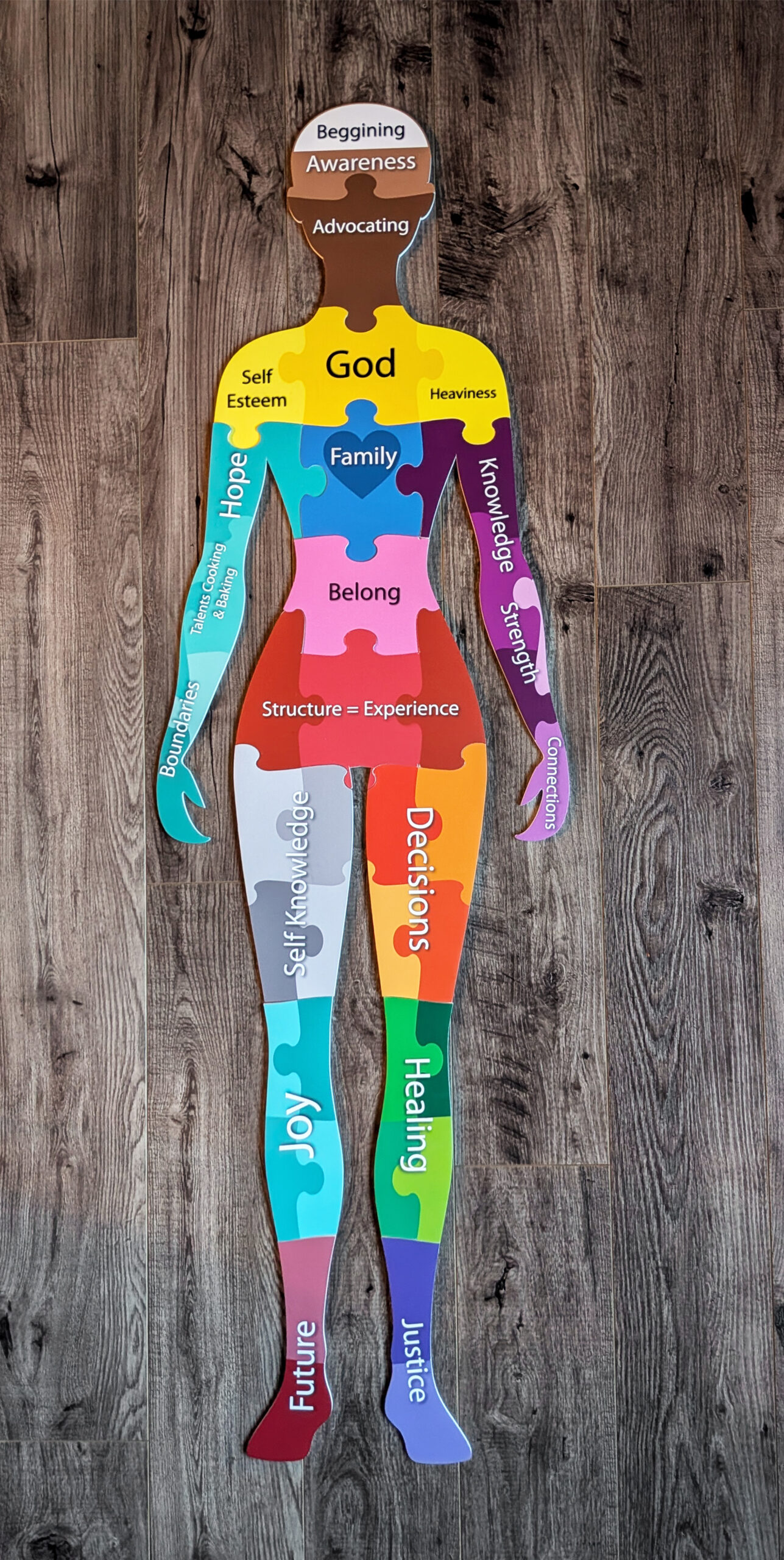
The freedom to create and express my thoughts, feelings, and experiences made learning even more enjoyable. The connection to the subject matter, the knowledge, the professors, and my classmates enriched both me and the course.
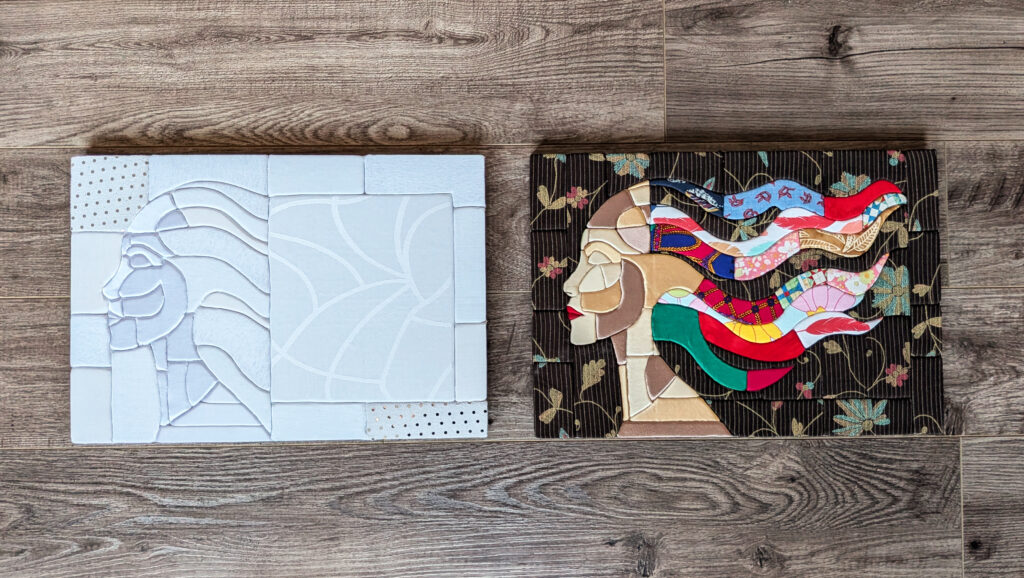
The Art, Media & Dissent: Bridging the Local & Global from Guerrilla Girls to the #MeToo Movement course allowed me to dive deep into Feminist movements and to express myself as art. Art is something I love, and I genuinely believe it is an impactful way to connect with people and share knowledge in a meaningful way. Art is also a process of healing and women’s empowerment, offering us the opportunity to discover hidden talents. In this art, I demonstrate intersectionality in feminism. The white piece represents feminism seen from a white, high-class woman’s perspective: a strong and beautiful face, but hair waves confined inside a box, moving only within themselves, a segregated feminism. The coloured piece represents all women, each with their own experiences and the challenges they must face to gain space in an unequal society. When we include colour and differences, we see movement, fluidity, and inclusion. Inclusion brings us unity, justice, and a flowery background.
“It’s not about being perfect. It’s not about where you get yourself in the end. There’s power in allowing yourself to be known and heard, in owning your unique story, in using your authentic voice. And there’s grace in being willing to know and hear others. This, for me, is how we become.” (Obama, 2018, p. 419)
Reference
Obama, M. (2018). Becoming (First edition). Crown.
Wilson, S. (2008). Research is Ceremony: Indigenous Research Methods. Fernwood Publishing.